Using Visual Studio For Mac Asp.net Core Mvc
NET Core MVC Project Using Visual Studio Code March 3, 2018 partho — No Comments This post shows you how to get started with an MVC project using Visual Studio Code – the lightweight IDE by Microsoft. Complete the New ASP.NET Core Web Application (.NET Core) - MvcMovie dialog: Visual Studio used a default template for the MVC project you just created. You have a working app right now by entering a project name and selecting a few options. This is a basic starter project, and it's a good place to. ASP.NET Core is the open-source, cross-platform evolution of Microsoft’s ASP.NET web framework. It can run on Windows, Mac, and Linux, and provides a powerful platform for building MVC-style web applications and REST APIs.
By Mike Wasson and Rick Anderson
HTTP is not just for serving up web pages. It’s also a powerful platform for building APIs that expose services and data. HTTP is simple, flexible, and ubiquitous. Almost any platform that you can think of has an HTTP library, so HTTP services can reach a broad range of clients, including browsers, mobile devices, and traditional desktop apps.
In this tutorial, you’ll build a simple web API for managing a list of “to-do” items. You won’t build any UI in this tutorial.

ASP.NET Core has built-in support for MVC building Web APIs. Unifying the two frameworks makes it simpler to build apps that include both UI (HTML) and APIs, because now they share the same code base and pipeline.
Note
If you are porting an existing Web API app to ASP.NET Core, see Migrating from ASP.NET Web API
Sections:
Here is the API that you’ll create:
| API | Description | Request body | Response body |
|---|---|---|---|
| GET /api/todo | Get all to-do items | None | Array of to-do items |
| GET /api/todo/{id} | Get an item by ID | None | To-do item |
| POST /api/todo | Add a new item | To-do item | To-do item |
| PUT /api/todo/{id} | Update an existing item | To-do item | None |
| PATCH /api/todo/{id} | Update an existing item | To-do item | None |
| DELETE /api/todo/{id} | Delete an item. | None | None |
The following diagram show the basic design of the app.
- The client is whatever consumes the web API (browser, mobile app, and so forth). We aren’t writing a client in this tutorial. We’ll use Postman to test the app.
- A model is an object that represents the data in your application. In this case, the only model is a to-do item. Models are represented as simple C# classes (POCOs).
- A controller is an object that handles HTTP requests and creates the HTTP response. This app will have a single controller.
- To keep the tutorial simple, the app doesn’t use a database. Instead, it just keeps to-do items in memory. But we’ll still include a (trivial) data access layer, to illustrate the separation between the web API and the data layer. For a tutorial that uses a database, see Building your first ASP.NET Core MVC app with Visual Studio.
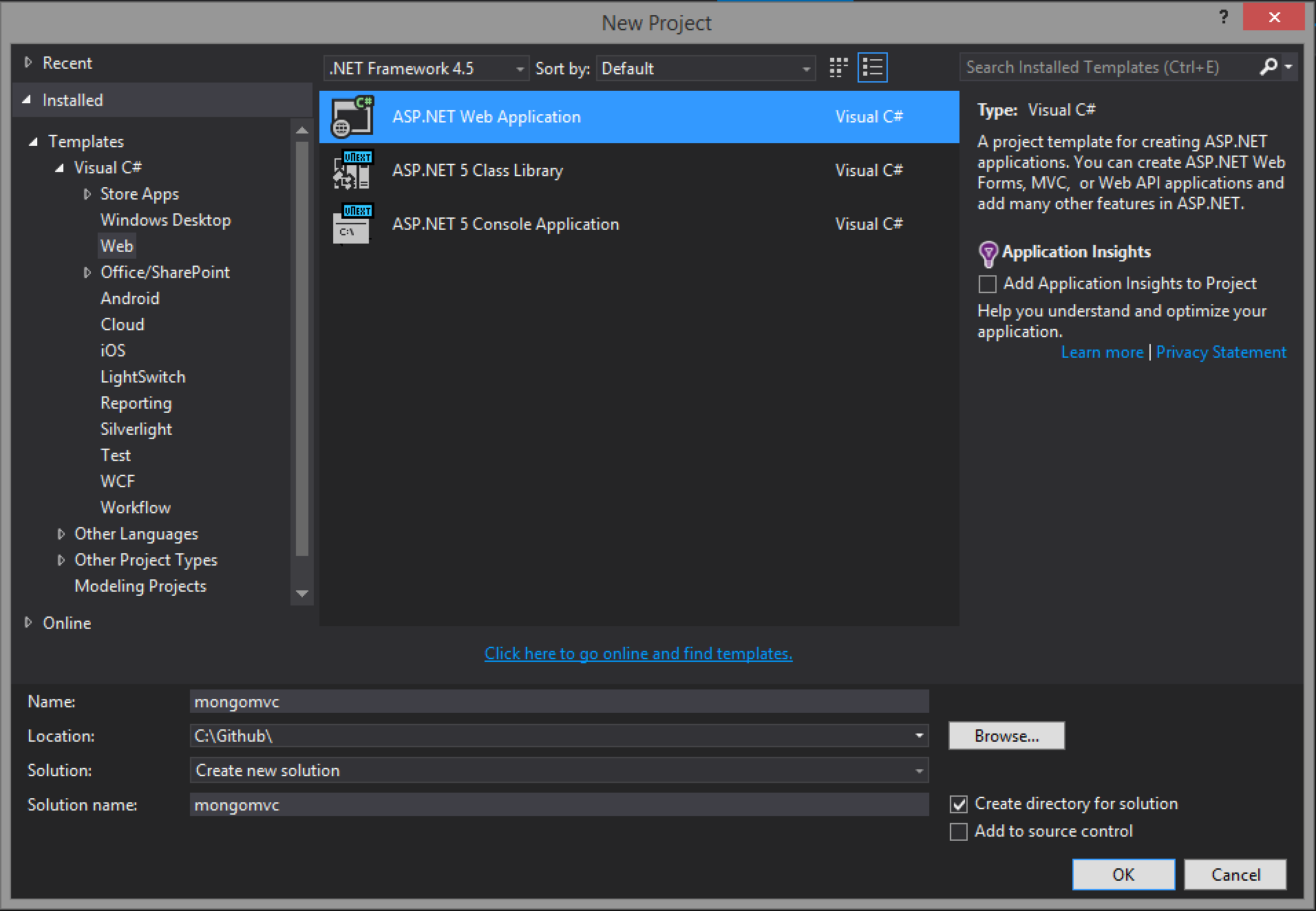
Start Visual Studio. From the File menu, select New > Project.
Select the ASP.NET Core Web Application (.NET Core) project template. Name the project TodoApi, clear Host in the cloud, and tap OK.
In the New ASP.NET Core Web Application (.NET Core) - TodoApi dialog, select the Web API template. Tap OK.
A model is an object that represents the data in your application. In this case, the only model is a to-do item.
Add a folder named “Models”. In Solution Explorer, right-click the project. Select Add > New Folder. Name the folder Models.
Note
You can put model classes anywhere in your project, but the Models folder is used by convention.
Add a TodoItem class. Right-click the Models folder and select Add > Class. Name the class TodoItem and tap Add.
Replace the generated code with:
A repository is an object that encapsulates the data layer, and contains logic for retrieving data and mapping it to an entity model. Even though the example app doesn’t use a database, it’s useful to see how you can inject a repository into your controllers. Create the repository code in the Models folder.
Start by defining a repository interface named ITodoRepository. Use the class template (Add New Item > Class).
Visual Studio For Mac Download
This interface defines basic CRUD operations.
Next, add a TodoRepository class that implements ITodoRepository:
Build the app to verify you don’t have any compiler errors.
By defining a repository interface, we can decouple the repository class from the MVC controller that uses it. Instead of instantiating a TodoRepository inside the controller we will inject an ITodoRepository using the built-in support in ASP.NET Core for dependency injection.
This approach makes it easier to unit test your controllers. Unit tests should inject a mock or stub version of ITodoRepository. That way, the test narrowly targets the controller logic and not the data access layer.
In order to inject the repository into the controller, we need to register it with the DI container. Open the Startup.cs file. Add the following using directive:
In the ConfigureServices method, add the highlighted code:
In Solution Explorer, right-click the Controllers folder. Select Add > New Item. In the Add New Item dialog, select the Web API Controller Class template. Name the class TodoController.
Replace the generated code with the following:
This defines an empty controller class. In the next sections, we’ll add methods to implement the API.
To get to-do items, add the following methods to the TodoController class.
These methods implement the two GET methods:
GET/api/todoGET/api/todo/{id}
Here is an example HTTP response for the GetAll method:
Later in the tutorial I’ll show how you can view the HTTP response using Postman.
Routing and URL paths
The [HttpGet] attribute (HttpGetAttribute) specifies an HTTP GET method. The URL path for each method is constructed as follows:
- Take the template string in the controller’s route attribute,
[Route('api/[controller]')] - Replace “[Controller]” with the name of the controller, which is the controller class name minus the “Controller” suffix. For this sample, the controller class name is TodoController and the root name is “todo”. ASP.NET Core routing is not case sensitive.
- If the
[HttpGet]attribute has a template string, append that to the path. This sample doesn’t use a template string.
In the GetById method:
'{id}' is a placeholder variable for the ID of the todo item. When GetById is invoked, it assigns the value of “{id}” in the URL to the method’s id parameter.
Name='GetTodo' creates a named route and allows you to link to this route in an HTTP Response. I’ll explain it with an example later.
Using Visual Studio For Mac Asp Net Core Mvc Tutorial
Return values
The GetAll method returns an IEnumerable. MVC automatically serializes the object to JSON and writes the JSON into the body of the response message. The response code for this method is 200, assuming there are no unhandled exceptions. (Unhandled exceptions are translated into 5xx errors.)
In contrast, the GetById method returns the more general IActionResult type, which represents a wide range of return types. GetById has two different return types:
- If no item matches the requested ID, the method returns a 404 error. This is done by returning
NotFound. - Otherwise, the method returns 200 with a JSON response body. This is done by returning an
ObjectResult
Launch the app
In Visual Studio, press CTRL+F5 to launch the app. Visual Studio launches a browser and navigates to http://localhost:port/api/values, where port is a randomly chosen port number. If you’re using Chrome, Edge or Firefox, the data will be displayed. If you’re using IE, IE will prompt to you open or save the values.json file.
We’ll add Create, Update, and Delete methods to the controller. These are variations on a theme, so I’ll just show the code and highlight the main differences. Build the project after adding or changing code.
Create
This is an HTTP POST method, indicated by the [HttpPost] attribute. The [FromBody] attribute tells MVC to get the value of the to-do item from the body of the HTTP request.
The CreatedAtRoute method returns a 201 response, which is the standard response for an HTTP POST method that creates a new resource on the server. CreateAtRoute also adds a Location header to the response. The Location header specifies the URI of the newly created to-do item. See 10.2.2 201 Created.
Use Postman to send a Create request
- Set the HTTP method to
POST - Tap the Body radio button
- Tap the raw radio button
- Set the type to JSON
- In the key-value editor, enter a Todo item such as
{'Name':'<yourto-doitem>'} - Tap Send
Tap the Headers tab and copy the Location header:
You can use the Location header URI to access the resource you just created. Recall the GetById method created the 'GetTodo' named route:
Update
Update is similar to Create, but uses HTTP PUT. The response is 204 (No Content).According to the HTTP spec, a PUT request requires the client to send the entire updated entity, not just the deltas. To support partial updates, use HTTP PATCH.
Update with Patch
This overload is similar to the previously shown Update, but uses HTTP PATCH. The response is 204 (No Content).
Visual Studio For Mac Os
Delete
Visual Studio
The response is 204 (No Content).
Visual Studio For Mac Tutorial
- To learn about creating a backend for a native mobile app, see 🔧 Creating Backend Services for Native Mobile Applications.
- For information about deploying your API, see Publishing and Deployment.