Cannot Create Workspace In Visual Studio For Mac
It is easy to configure Visual Studio Code to your liking through its various settings. Nearly every part of VS Code's editor, user interface, and functional behavior has options you can modify.
VS Code provides two different scopes for settings:
- User Settings - Settings that apply globally to any instance of VS Code you open.
- Workspace Settings - Settings stored inside your workspace and only apply when the workspace is opened.
Workspace settings override user settings.
Creating User and Workspace Settings
To open your user and workspace settings, use the following VS Code menu command:
I try to manage workspaces in Visual Studio for mac with TFS extension. I don't have any workspace so I click on ManageWorkspaces in SourceControl Explorer. Then I click on add button in order to create a new workspace. It works great until here. I enter workspace name, then I select a working folder. I try to manage workspaces in Visual Studio for mac with TFS extension. I don't have any workspace so I click on ManageWorkspaces in SourceControl Explorer. Then I click on add button in order to create a new workspace. It works great until here. I enter workspace name, then I select a working folder.
- On Windows/Linux - File > Preferences > Settings
- On macOS - Code > Preferences > Settings
You can also open the Settings editor from the Command Palette (⇧⌘P (Windows, Linux Ctrl+Shift+P)) with Preferences: Open Settings or use the keyboard shortcut (⌘, (Windows, Linux Ctrl+,)).
In the example below, the color theme and the icon theme have been changed.
Changes to settings are reloaded by VS Code as you change them. Modified settings are now indicated with a blue line similar to modified lines in the editor. The gear icon opens a context menu with options to reset the setting to its default value as well as copy setting as JSON.
Note: Workspace settings are useful for sharing project specific settings across a team.
Settings editor
When you open the settings editor, you can search and discover settings you are looking for. When you search using the Search bar, it will not only show and highlight the settings matching your criteria, but also filter out those which are not matching. This makes finding settings quick and easy.
Note: VS Code extensions can also add their own custom settings and they will be visible under an Extensions section.
Edit settings
Visual Studio For Mac Download
Each setting can be edited by either a checkbox, an input or by a drop-down. Simply edit the text or select the option you want to change to the desired settings.
Settings groups
Default settings are represented in groups so that you can navigate them easily. It has a Commonly Used group at the top which shows popular customizations.
Below is a copy of the default settings that come with VS Code.
Settings file locations
By default VS Code shows the Settings editor, but you can still edit the underlying settings.json file by using the Open Settings (JSON) command or by changing your default settings editor with the workbench.settings.editor setting.
Depending on your platform, the user settings file is located here:
- Windows
%APPDATA%CodeUsersettings.json - macOS
$HOME/Library/Application Support/Code/User/settings.json - Linux
$HOME/.config/Code/User/settings.json
The workspace settings file is located under the .vscode folder in your root folder.
Note: In case of a Multi-root Workspace, workspace settings are located inside the workspace configuration file.
Language specific editor settings
To customize your editor by language, run the global command Preferences: Configure Language Specific Settings (command id: workbench.action.configureLanguageBasedSettings) from the Command Palette (⇧⌘P (Windows, Linux Ctrl+Shift+P)) which opens the language picker. Selecting the language you want, opens the Settings editor with the language entry where you can add applicable settings.
If you have a file open and you want to customize the editor for this file type, click on the Language Mode in the Status Bar to the bottom-right of the VS Code window. This opens the Language Mode picker with an option Configure 'language_name' language based settings. Selecting this opens the Settings editor with the language entry where you can add applicable settings.
You can also configure language based settings by directly opening settings.json. You can scope them to the workspace by placing them in the workspace settings just like other settings. If you have settings defined for a language in both user and workspace scopes, then they are merged by giving precedence to the ones defined in the workspace.
The following examples customize editor settings for language modes typescript and markdown.
You can use IntelliSense in Settings editor to help you find allowed language based settings. All editor settings and some non-editor settings are supported.
Settings and security
Some settings allow you to specify an executable that VS Code will run to perform certain operations. For example, you can choose which shell the Integrated Terminal should use. For enhanced security, such settings can only be defined in user settings and not at workspace scope.
Here is the list of settings not supported in workspace settings:
git.pathterminal.integrated.shell.linuxterminal.integrated.shellArgs.linuxterminal.integrated.shell.osxterminal.integrated.shellArgs.osxterminal.integrated.shell.windowsterminal.integrated.shellArgs.windowsterminal.external.windowsExecterminal.external.osxExecterminal.external.linuxExec
The first time you open a workspace which defines any of these settings, VS Code will warn you and subsequently always ignore the values after that.
Default settings
Below are the Visual Studio Code default settings and their values. You can also view the default values in the Settings editor.
Common questions
VS Code says 'Unable to write settings.'
If you try to change a setting (for example turning on Auto Save or selecting a new Color Theme) and you see 'Unable to write settings. Please open User Settings to correct errors/warnings in the file and try again.', it means your settings.json file is ill-formed or has errors. The errors can be as simple as a missing comma or setting value. Open the Settings editor File > Preferences > Settings (Code > Preferences > Settings on macOS) (⌘, (Windows, Linux Ctrl+,)) and you should see the error highlighted with red squiggles.
How can I reset my user settings?
The easiest way to reset VS Code back to the default settings is to clear your user settings.json file contents in the Settings editor. Delete everything between the two curly braces, save the file, and VS Code will go back to using the default values.
When does it make sense to use workspace settings?
If you're using a workspace that needs custom settings but you don't want to apply them to your other VS Code projects. A good example is language-specific linting rules.
While Visual Studio Code is the best IDE for sure but it is really difficult and tiring to try without guide. Here is how to setup Visual Studio Code on Mac for debugging Arduino, WordPress etc common things for the iTerm2 + ZSH + Homebrew Users. Those who have not setup their Mac with iTerm2, ZSH, Homebrew should read our old guide to setup. Then realize the matters of .profile file – we use ~/.zshrc as profile file. Other matter is understanding UNIX Wheel group. Obviously, as first step you need to download Visual Studio Code on Mac via GUI from official website :

Following our guide, Mac users will not face any error. Peoples forget what installed which things and get odd errors with PHPCS. Your everything’s path should be on ~/.zshrc. Otherwise any debugger will fail. I am writing like poet. If you find any error in the poetry please inform me via Twitter.
Setup Visual Studio Code on Mac For Debugging
Skip steps which First upgrade Xcode and restart the system. After that is complete, open iTerm2 and run :
Then run :
and kindly fix all possible problems (it is not uncommon to see errors in long term). Then run :
You’ll receive a friendly message :
Visual Studio For Mac Os
2 4 6 | export PATH='/usr/local/opt/icu4c/sbin:$PATH' export PATH='$(brew --prefix homebrew/php/php70)/bin:$PATH' PATH='/usr/local/sbin:$PATH' |
Reload after addition :
Now install Mcrypt :
Now install Composer :
If you run :
You’ll get a valid path. Now Run this command :
Advertisement---
Cannot Create Workspace In Visual Studio For Machine
Microsoft Visual Studio For Mac
2 4 6 8 | Changed current directory to/Users/your-user-name-on-mac/.composer Loading composer repositories with package information Package operations:1install,0updates,0removals -Installing squizlabs/php_codesniffer(3.1.0):Downloading(100%) Generating autoload files |
Run :
Basically we installed PHPCS :
Add this to ~/.zshrc :
Reload after addition :
Run :
For the sake of Python stuffs install pylint :
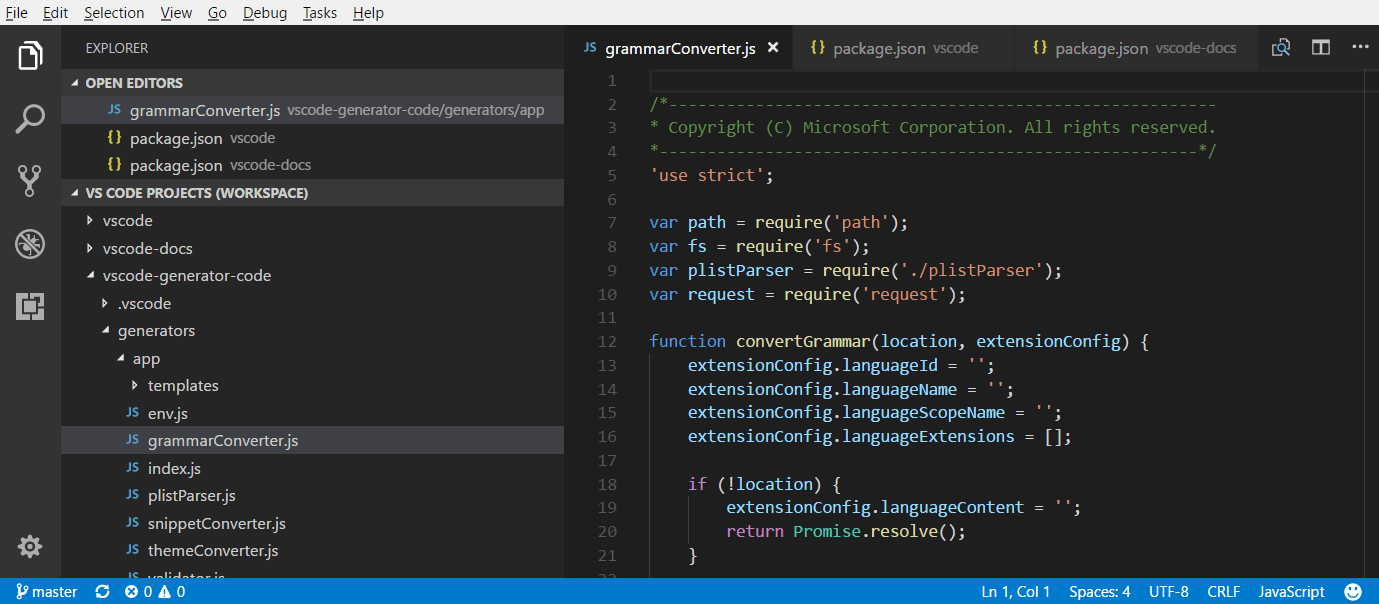
Now launch Visual Studio Code. On the left hand side there are 5 icons :
File icon = Explorer
Magnifying glass icon = Search
Git tree icon = Source control
No Bug icon = Debugging
Square icon = Extensions
Click that Extension’s square icon and install these extensions :
Arduino
C/C++
C#
Composer
Docker
Hg
jQuery Code Snippets
MagicPython
PHP Debug
phpcs 0.7.0 by Ioannis Kappas (Do not install some other than Ioannis Kappas’s thing)
Project Manager
Python
Python for VSCode
Wordpress Development by Hridoy
WordPress Snippet
Restart VSCode. You should not receive any error. This ends first part of the guide. Second part is about what to do with WordPress. For Arduino you should have Arduino IDE installed as advice for the third part.